Great to see they featured the female adder I found for BBC Autumnwatch on last night's programme.
Also the hornets and wild boar, although all credit goes to them for actually finding the wild boars. I just put them in the right location.
A massive thank you to all three presenters for standing up for the wild boars in the UK, a creature very close to my heart.
CLICK HERE FOR AUTUMNWATCH; EPISODE 1
Rob
Showing posts with label "vipera berus". Show all posts
Showing posts with label "vipera berus". Show all posts
Saturday, 8 October 2011


Saturday, 1 October 2011
BBC Autumnwatch are Here!
Today I spent the morning with a film crew from BBC Autumnwatch. The main subject was supposed to be wild boar and although I found them a fantastic location (filming tonight), I couldn't resist taking them to one of my adder hot-spots!
It wasn't long before I found a lovely "big" female for them to film and although she was quite shy, hopefully they captured enough decent footage to be included in the programme.
I also found them some hornets building a nest! This was something I really didn't expect to find as this species dies off during the winter months, so this is not really the best time to start building a nest. We are seeing some unusually hot weather at the moment and this is probably the reason for this unusual activity.
Will be on TV next Friday, so get tuned in!
Rob
It wasn't long before I found a lovely "big" female for them to film and although she was quite shy, hopefully they captured enough decent footage to be included in the programme.
I also found them some hornets building a nest! This was something I really didn't expect to find as this species dies off during the winter months, so this is not really the best time to start building a nest. We are seeing some unusually hot weather at the moment and this is probably the reason for this unusual activity.
Will be on TV next Friday, so get tuned in!
Rob
Thursday, 8 September 2011
Snake Found in Bedroom!
I was contacted by the Cheltenham Echo yesterday to identify a snake that a local resident had found in his home. At first I thought I was going to see a pet corn snake or a young python, but I was shocked to see that it was an adder. Britain's only venomous snake!
Click link below for full article.
Snake Article
Rob
Click link below for full article.
Snake Article
Rob
Thursday, 4 August 2011
Success!
You may remember my post earlier this year when I, along with a friend carried some heavy corrugated tin, on our heads to a location in the Forest of Dean.
This tin was to give the adders some artificial refuge and help with the decline in their numbers in this area.
After giving the reptiles time to get used to the change in their habitat and explore it, I went back for the first time yesterday evening. Although the tin was nearly covered by bracken I managed to take a look underneath and success as the first piece had two slow worms underneath. This was great to see as adders share the same basking spots as the slow worm, so I moved on to the next piece hoping to see one taking advantage of it!
Nothing under the second piece except a large ant nest, so I re-positioned it in a different location.
I dug my way in through the bracken to the third piece and lifted it up. There she was, a lovely female adder, coiled up right in the centre.
I was over the moon and this just shows what a little hard work and determination can achieve!
No pics of the adder I'm afraid, for a couple of reasons.
1. I didn't want to disturb her, so the tin was carefully placed back down straight away.
2. It would have been hard taking a photograph one handed!
A massive thank you to my friend Mark Dando for his help and an equal amount of credit is due to him for helping a species in decline, in the Forest of Dean!
Rob
This tin was to give the adders some artificial refuge and help with the decline in their numbers in this area.
After giving the reptiles time to get used to the change in their habitat and explore it, I went back for the first time yesterday evening. Although the tin was nearly covered by bracken I managed to take a look underneath and success as the first piece had two slow worms underneath. This was great to see as adders share the same basking spots as the slow worm, so I moved on to the next piece hoping to see one taking advantage of it!
Nothing under the second piece except a large ant nest, so I re-positioned it in a different location.
I dug my way in through the bracken to the third piece and lifted it up. There she was, a lovely female adder, coiled up right in the centre.
I was over the moon and this just shows what a little hard work and determination can achieve!
No pics of the adder I'm afraid, for a couple of reasons.
1. I didn't want to disturb her, so the tin was carefully placed back down straight away.
2. It would have been hard taking a photograph one handed!
A massive thank you to my friend Mark Dando for his help and an equal amount of credit is due to him for helping a species in decline, in the Forest of Dean!
Rob
Friday, 1 July 2011
An Hour With the Adders!
Had a good day with the adders this morning. Found 5 in total and all of them were females ranging from a tiny juvenile to a fully grown lady!
I was bitten by some nasties and got bramble scars all over my legs, but it was my own fault for lying in them while wearing shorts!
The tiny one. Around 9 inches long and a feisty girl. She wasn't too bothered and was quite inquisitive.


And here is mum basking just around the corner.

Same female except this time uncoiled and stretched out!

Another female under a gorse bush. I don't push to get too close to the larger adders as they are more timid than the little ones and it would only disturb them. Anyway, it's nice to see them in their natural habitat.

Rob
I was bitten by some nasties and got bramble scars all over my legs, but it was my own fault for lying in them while wearing shorts!
The tiny one. Around 9 inches long and a feisty girl. She wasn't too bothered and was quite inquisitive.


And here is mum basking just around the corner.

Same female except this time uncoiled and stretched out!

Another female under a gorse bush. I don't push to get too close to the larger adders as they are more timid than the little ones and it would only disturb them. Anyway, it's nice to see them in their natural habitat.

Rob
Thursday, 30 June 2011
Male Adder!
Not a great pic I know, but this male adder was in a gorse bush (they usually are) and it was tricky to get a decent angle.
Unless I can get down to their level, I don't get too close because this just disturbs them and I would rather walk away with a crappy shot than disturb this reptile just for the sake of a photograph!
Will hopefully be getting out tomorrow weather permitting!

Rob
Unless I can get down to their level, I don't get too close because this just disturbs them and I would rather walk away with a crappy shot than disturb this reptile just for the sake of a photograph!
Will hopefully be getting out tomorrow weather permitting!

Rob
Saturday, 7 May 2011
Nine Year Old Girl Bitten by Adder in New Forest!
It happens quite a lot, but when it happens to a young child it is a worrying time. The adder's bite is not that serious, unless you get a allergic reaction called anaphylactic shock, or Anaphylaxis and then it can be very serious, even fatal if untreated!
Unfortunately, nine year old Tylar Butcher was recently bitten while holidaying with her family in the New Forest and suffered an allergic reaction, which required hospital treatment. Thankfully she is making an excellent recovery and has even shown an interest in the adder. This is great news as it will have a very positive impact on the way certain people think and react towards this snake.
The adder has been persecuted for years, for just being able to defend itself and as humans we see it as a threat, so we kill it. Thankfully we are not all like this and some of us want to protect them. I hope Tylar will grow up wanting to help protect them too!
Read Tylar's STORY HERE

Rob
Unfortunately, nine year old Tylar Butcher was recently bitten while holidaying with her family in the New Forest and suffered an allergic reaction, which required hospital treatment. Thankfully she is making an excellent recovery and has even shown an interest in the adder. This is great news as it will have a very positive impact on the way certain people think and react towards this snake.
The adder has been persecuted for years, for just being able to defend itself and as humans we see it as a threat, so we kill it. Thankfully we are not all like this and some of us want to protect them. I hope Tylar will grow up wanting to help protect them too!
Read Tylar's STORY HERE

Rob
Saturday, 16 April 2011
Worrying Times!
As you have most probably heard on the radio or seen on the TV, our native adder is in trouble!
National statistics have shown that adder numbers are dropping throughout the country and the Forest of Dean is one area for concern.
I have been surveying for NARRS from day one (2007) and I have also been monitoring my snake locations for more than 20 years.
During one visit to one of my hot spots back in April 2005 I found 18 snakes in approx 1 hour. I visited he same area at the same time this year and found just one grass snake and no adders! Very disturbing!
However, I did find these two females at a spot, which has not been fruitful over the years and hopefully there will be a few fella's around soon.
No close up's today as they were tucked under a small tree and gorse bush and if I had pushed to get close it would have disturbed them.


Rob
National statistics have shown that adder numbers are dropping throughout the country and the Forest of Dean is one area for concern.
I have been surveying for NARRS from day one (2007) and I have also been monitoring my snake locations for more than 20 years.
During one visit to one of my hot spots back in April 2005 I found 18 snakes in approx 1 hour. I visited he same area at the same time this year and found just one grass snake and no adders! Very disturbing!
However, I did find these two females at a spot, which has not been fruitful over the years and hopefully there will be a few fella's around soon.
No close up's today as they were tucked under a small tree and gorse bush and if I had pushed to get close it would have disturbed them.


Rob
Wednesday, 24 November 2010
Ambush Predator!
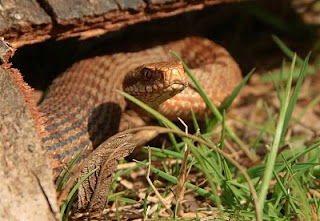
You can sometimes find snakes around log piles while walking in the forest. Their prey will use the logs and bark as protection, but where there is prey, the predator is not far away!
You can commonly see lizards basking on top of the logs, but out of sight, under the logs are newts, frogs and toads, all of which are prey species to our snakes.
The female in the photograph below has obviously already been successful in finding one the the named above as she has a full belly.
A snakes skin is elasticated and will stretch to take a hefty meal on board. You can see by this females scales that her skin has stretched considerably, meaning she is probably digesting a small frog or toad!
When I found her all I could see was a small area of body scales, so I got the camera ready and crept forward. She sensed (or probably) saw me, then poked her head out and told me to hiss off!
I took a few pics and left her to fully digest her meal in peace. This is probably where she caught her snack.
Rob
You can commonly see lizards basking on top of the logs, but out of sight, under the logs are newts, frogs and toads, all of which are prey species to our snakes.
The female in the photograph below has obviously already been successful in finding one the the named above as she has a full belly.
A snakes skin is elasticated and will stretch to take a hefty meal on board. You can see by this females scales that her skin has stretched considerably, meaning she is probably digesting a small frog or toad!
When I found her all I could see was a small area of body scales, so I got the camera ready and crept forward. She sensed (or probably) saw me, then poked her head out and told me to hiss off!
I took a few pics and left her to fully digest her meal in peace. This is probably where she caught her snack.

Rob
Tuesday, 23 November 2010
Basking Melanistic Adder
Here we have a melanistic adder, probably a male. Melanism is a condition, which means the animal has an increased amount of black pigment throughout their body. This can be slight, or in some cases it can be so severe that the whole body is completely black.
You will notice that he is resting his chin on his mid-body section and that this part of his body looks flat.
The reason for this is the fact that a snake can flatten their body to create a larger surface area. The bigger the surface area means more sun penetration and heat can be absorbed.
Its tough work getting close to a shy and elusive creature like the adder, but stealth, understanding and patience is the key to getting close without disturbing them.
This photograph was taken with a 100mm macro lens and I was probably no more than 12 inches away, but even though he could see me, he was fine as I was making no sudden movements and was at his level.
Why do I feel the need to get so close? That's simple, I love these creatures and when I see certain TV presenters tailing these beautiful reptiles, swinging them around (whilst trying not to be bitten), it makes me mad.
I could pick up every snake in my photographs if I wanted to, but for what purpose? I have no idea why these presenters feel the need to man handle the snakes they find, maybe the producers think it makes better TV?
I have hours of video, where our snakes are in their natural habitat (acting normal). Some of this footage can be slightly boring, I admit it as a basking snake is not very entertaining, but if these presenters were swung around by their legs for about 10 minuets, I'm pretty sure they would be very upset and want to punch the person doing it.
Snakes don't have hands to defend themselves, they have fangs and 9 times out of 10, all snake bites are preventable.

Rob
You will notice that he is resting his chin on his mid-body section and that this part of his body looks flat.
The reason for this is the fact that a snake can flatten their body to create a larger surface area. The bigger the surface area means more sun penetration and heat can be absorbed.
Its tough work getting close to a shy and elusive creature like the adder, but stealth, understanding and patience is the key to getting close without disturbing them.
This photograph was taken with a 100mm macro lens and I was probably no more than 12 inches away, but even though he could see me, he was fine as I was making no sudden movements and was at his level.
Why do I feel the need to get so close? That's simple, I love these creatures and when I see certain TV presenters tailing these beautiful reptiles, swinging them around (whilst trying not to be bitten), it makes me mad.
I could pick up every snake in my photographs if I wanted to, but for what purpose? I have no idea why these presenters feel the need to man handle the snakes they find, maybe the producers think it makes better TV?
I have hours of video, where our snakes are in their natural habitat (acting normal). Some of this footage can be slightly boring, I admit it as a basking snake is not very entertaining, but if these presenters were swung around by their legs for about 10 minuets, I'm pretty sure they would be very upset and want to punch the person doing it.
Snakes don't have hands to defend themselves, they have fangs and 9 times out of 10, all snake bites are preventable.

Rob
Monday, 22 November 2010
Persecution!
The snake has always been persecuted and probably always will be. The problem comes from a lack of education, scaremongering and from the way they have been portrayed on TV and in the press.
It goes right back to the beginning of time and the serpent is seen as evil in many countries, but also worshiped in others.
Why do people have a fear of these creatures? If a young child with no understanding of the dangers of venomous creatures saw a snake, would they run away, or try and pick it up?
For many years, people have been telling their children that snakes are dangerous. This is correct as some can kill a human being in minuets, but surely we should be educating our children to respect the snake, not fear it.
The UK has one venomous snake, the adder and although this snake is venomous, its venom will only prove fatal if the victim suffers a severe allergic reaction, which is not treated.
The same allergic reaction can be caused from a bee sting, so in reality the adder is about as harmless as a bee.
The snake below is a male adder. I found him near one of my adder hot-spots and he was probably basking on the path when someone came along and decided he had to die!
Probably beaten to death with a stick, he would have suffered a great deal of pain and died a slow death.
The person who killed this snake, did so out of ignorance, as when they saw him the kill instinct kicked in and the snake didn't stand a chance.
They probably thought they had done a good deed, by removing a pest from our forest, but in fact they removed a protected species, which is in decline.
Education is the key to conservation.

Rob
It goes right back to the beginning of time and the serpent is seen as evil in many countries, but also worshiped in others.
Why do people have a fear of these creatures? If a young child with no understanding of the dangers of venomous creatures saw a snake, would they run away, or try and pick it up?
For many years, people have been telling their children that snakes are dangerous. This is correct as some can kill a human being in minuets, but surely we should be educating our children to respect the snake, not fear it.
The UK has one venomous snake, the adder and although this snake is venomous, its venom will only prove fatal if the victim suffers a severe allergic reaction, which is not treated.
The same allergic reaction can be caused from a bee sting, so in reality the adder is about as harmless as a bee.
The snake below is a male adder. I found him near one of my adder hot-spots and he was probably basking on the path when someone came along and decided he had to die!
Probably beaten to death with a stick, he would have suffered a great deal of pain and died a slow death.
The person who killed this snake, did so out of ignorance, as when they saw him the kill instinct kicked in and the snake didn't stand a chance.
They probably thought they had done a good deed, by removing a pest from our forest, but in fact they removed a protected species, which is in decline.
Education is the key to conservation.

Rob
Sunday, 21 November 2010
I've Got My Eye On You!
Even though I feel completely safe and in no danger when photographing the adder today, I also understand that I would be foolish to become complacent.
In the early days I did just that and was bitten by a mature female. Looking back at that incident now, I feel like an idiot for being too gung-ho and it must have been quite stressful for the snake involved!
Sometimes a snake will give a dry bite where they hold back the venom. This is just a warning bite as they have seen the target as non threatening to their life and want them to leave.
Failure to do this will invite an envenomation and as it takes a huge amount of the snakes energy to produce venom, which it will later rely on for catching a meal, this is not a good scenario for "all" involved!
It was an envenomation when I was bitten, purely because she was in the open and I was in her face. I have learnt a lot over the years and "respect" for this creature is on top of my list.
The adder in the photograph below is a young female and she decided to take a close look at me while I was photographing her older brothers and sisters.
Once again I was on my belly, using a beanbag as a support, but sometimes you have to move away from the support and hand hold if a snake is out of shot.
I had moved away from the support of the beanbag and was photographing an adult male. I was probably away from the beanbag for only 2 - 3 minuets, but I have learnt that when you are in the snakes garden, be careful where you tread and always check the area before you move.
I slowly looked back towards the beanbag and this is when I saw her head resting on top of it! As quick as a flash I took this photograph and she then moved away.
I guess I have been lucky that I have not been bitten more often, but having the utmost respect for these magnificent reptiles has helped me learn a lot about them and I will keep learning for the rest of my life.

Rob
In the early days I did just that and was bitten by a mature female. Looking back at that incident now, I feel like an idiot for being too gung-ho and it must have been quite stressful for the snake involved!
Sometimes a snake will give a dry bite where they hold back the venom. This is just a warning bite as they have seen the target as non threatening to their life and want them to leave.
Failure to do this will invite an envenomation and as it takes a huge amount of the snakes energy to produce venom, which it will later rely on for catching a meal, this is not a good scenario for "all" involved!
It was an envenomation when I was bitten, purely because she was in the open and I was in her face. I have learnt a lot over the years and "respect" for this creature is on top of my list.
The adder in the photograph below is a young female and she decided to take a close look at me while I was photographing her older brothers and sisters.
Once again I was on my belly, using a beanbag as a support, but sometimes you have to move away from the support and hand hold if a snake is out of shot.
I had moved away from the support of the beanbag and was photographing an adult male. I was probably away from the beanbag for only 2 - 3 minuets, but I have learnt that when you are in the snakes garden, be careful where you tread and always check the area before you move.
I slowly looked back towards the beanbag and this is when I saw her head resting on top of it! As quick as a flash I took this photograph and she then moved away.
I guess I have been lucky that I have not been bitten more often, but having the utmost respect for these magnificent reptiles has helped me learn a lot about them and I will keep learning for the rest of my life.

Rob
Friday, 19 November 2010
Photo Comp - Winner!
I am very excited and chuffed to bits to have won the Wildlife Portraits Category with my female adder portrait - with Gloucestershire Wildlife Trust.
The pic entered is the one I am using as a header for this blog, as it is one of my favourite photographs and one of my best encounters to date.
Wildlife conservation comes in many forms and one of the best is education. I love our snakes, not just because they are one of the most efficient creatures on our planet, but also because they are gravely misunderstood and this has led to them being persecuted by many, over thousands of years.
Competition Winners
I was surveying one of my local areas for the adder back in 2007 when I saw this female making her way through a gorse bush. I watched her for a while to try and determine her path and then positioned myself where I thought she would pop out!
There were other adders in the vicinity, so I had to be careful while sitting down in the gorse bush (quite painful!)
At this point I could not see her, so I had to just sit there patiently waiting and hoping that she was coming my way.
Then I saw some movement, so I quickly, but calmly raised my camera to my eye and waited. She came through the gorse bush directly in front of me and this is when I took this shot.
She saw me almost immediately and hissed, but as I was low to the ground and very still, she stayed put. This gave me the opportunity to photograph her moving around in the gorse.
After she left, I was excited as I knew I had managed to get some good photographs of her, but at the same time I was disappointed as I knew opportunities like this are very hard to come by and it may be years before the next one arises.

Rob
The pic entered is the one I am using as a header for this blog, as it is one of my favourite photographs and one of my best encounters to date.
Wildlife conservation comes in many forms and one of the best is education. I love our snakes, not just because they are one of the most efficient creatures on our planet, but also because they are gravely misunderstood and this has led to them being persecuted by many, over thousands of years.
Competition Winners
I was surveying one of my local areas for the adder back in 2007 when I saw this female making her way through a gorse bush. I watched her for a while to try and determine her path and then positioned myself where I thought she would pop out!
There were other adders in the vicinity, so I had to be careful while sitting down in the gorse bush (quite painful!)
At this point I could not see her, so I had to just sit there patiently waiting and hoping that she was coming my way.
Then I saw some movement, so I quickly, but calmly raised my camera to my eye and waited. She came through the gorse bush directly in front of me and this is when I took this shot.
She saw me almost immediately and hissed, but as I was low to the ground and very still, she stayed put. This gave me the opportunity to photograph her moving around in the gorse.
After she left, I was excited as I knew I had managed to get some good photographs of her, but at the same time I was disappointed as I knew opportunities like this are very hard to come by and it may be years before the next one arises.

Rob
Wednesday, 17 November 2010
Adders Mating!
As mentioned previously, I spend a lot of up close and personal time with our snakes, including the adder. Saying this, there are times when they need their space and during the mating season, I stay well back and respect the fact that they are very sensitive and secretive creatures.
While they are mating I photograph them from a distance that doesn't disturb them. The only draw back to this is that there is usually grass and reed in between them and my camera, so this inevitably ends up in the shot!
Here we have two mating adders. You can easily tell the female from the male due to her size and brown colour. She is also the same snake, which is featured in the grass snake pic below.
Female adders, like the female grass snakes grow much larger than the males and I have found some truly magnificent specimens while surveying the Forest of Dean for them.
The largest female adder I have found and photographed was approx 80cm and was very bulky, she was tucked under a small tree with gorse all around to shelter and protect her. Very beautiful snake and I will post her portrait soon.

Rob
While they are mating I photograph them from a distance that doesn't disturb them. The only draw back to this is that there is usually grass and reed in between them and my camera, so this inevitably ends up in the shot!
Here we have two mating adders. You can easily tell the female from the male due to her size and brown colour. She is also the same snake, which is featured in the grass snake pic below.
Female adders, like the female grass snakes grow much larger than the males and I have found some truly magnificent specimens while surveying the Forest of Dean for them.
The largest female adder I have found and photographed was approx 80cm and was very bulky, she was tucked under a small tree with gorse all around to shelter and protect her. Very beautiful snake and I will post her portrait soon.

Rob
Friday, 12 November 2010
Identification Part 2
Here we have two mating grass snakes and a female adder, all in the same shot. You can now see the difference between the two with the female adder standing out from the grass snakes with her zig-zag pattern and ginger brown colour.
I never disturb them and I photographed these snakes from quite a distance, hence the distracting reeds in front of them, but I would rather have a messy shot, than know I had disturbed them. Especially when they are mating!

Rob
I never disturb them and I photographed these snakes from quite a distance, hence the distracting reeds in front of them, but I would rather have a messy shot, than know I had disturbed them. Especially when they are mating!

Rob
Adder & Grass Snake Identification
Here are the sloughed skins of a female adder and a grass snake. I can tell the difference between these snakes within a millisecond, but for all the people that are unsure, these pointers will help you id a snake if you are lucky enough to see one in the wild.
Grass snake:
Dark green / olive colour with dark dotted scales running down the body.
Yellow collar around the back of the head. Vibrant in younger snakes, duller in older ones.
Orange eye with a round pupil.
No V on back of head, like the adder.
Adder:
Females are brown, with a darker brown zig-zag pattern running the entire length of the body. Whereas the male adder is grey with a dark, almost black zig-zag.
Red eye with a vertical pupil.
Has a V on back of the head.
I will post a photograph soon of the adder and grass snake together.

Rob
Grass snake:
Dark green / olive colour with dark dotted scales running down the body.
Yellow collar around the back of the head. Vibrant in younger snakes, duller in older ones.
Orange eye with a round pupil.
No V on back of head, like the adder.
Adder:
Females are brown, with a darker brown zig-zag pattern running the entire length of the body. Whereas the male adder is grey with a dark, almost black zig-zag.
Red eye with a vertical pupil.
Has a V on back of the head.
I will post a photograph soon of the adder and grass snake together.

Rob
3 is a Crowd!
This is a very old photograph of two male adders that I photographed at one of my adder hot spots. Digital cameras were not on the market back then, so I was using a Canon EOS 50e and as I could not afford a macro lens, I compromised!
Using a 400mm lens with 3 extension tubes gave me the means of being able to focus at close range.
The only draw back was that I had to manually focus and it severely reduced my shutter speed. On top of this I was lying on my belly in brambles, which meant a tripod was not suitable for these conditions. Hand holding a 400mm lens, manually focusing with a slow shutter speed = hard work, especially when inches away from two adders! But it paid off and this was the result.
As soon as our snakes emerge from hibernation, they usually head to an area where there is a good food source and good basking spots. If you are lucky enough to find one of these areas, you can see the same snakes and new arrivals there year after year, as long as they are not disturbed.
I can usually identify old snakes and it is good to see them every year.

Rob
Using a 400mm lens with 3 extension tubes gave me the means of being able to focus at close range.
The only draw back was that I had to manually focus and it severely reduced my shutter speed. On top of this I was lying on my belly in brambles, which meant a tripod was not suitable for these conditions. Hand holding a 400mm lens, manually focusing with a slow shutter speed = hard work, especially when inches away from two adders! But it paid off and this was the result.
As soon as our snakes emerge from hibernation, they usually head to an area where there is a good food source and good basking spots. If you are lucky enough to find one of these areas, you can see the same snakes and new arrivals there year after year, as long as they are not disturbed.
I can usually identify old snakes and it is good to see them every year.

Rob
Thursday, 11 November 2010
How it all Began!
I was 8 years old when I saw my first snake in the Forest of Dean. I was out walking in the forest with my parents one day and was approx 15 - 20 feet in front of them when I saw it.
It was stretched out from the verge, basking on the Forestry Commission path and looked enormous! I was young, so this made it look big to me, but I didn't care, I just stood there staring at it!
My mum and dad walked up and my dad said "that's an adder, don't get any closer!"
We stood there and watched as it slowly made its way back into the grass verge and I can remember it like it was yesterday. I now know that we were watching a female adder because of her colour, females are brown and males are black and grey.
It was at that precise moment when my fascination with snakes started. Every time I went out, I would be looking for snakes, nothing else.
I was a teenager when I saw my next snake, a male adder curled around some exposed tree roots. Again my dad helped me find this snake and I still monitor and survey this area for adders and grass snakes today.
You have to learn how to behave around wildlife and snakes are no different. You must treat them with the utmost respect at all times and if you are disturbing them, you must walk away.
When I photograph snakes I am usually between 6 inches and 3 feet away from them, as this is required to capture the detail. They are not restrained in any way and if they felt threatened they would disappear in a flash!
My technique has taken me a long time to perfect so that I don't disturb them. I read their body language and I have even had a male adder lick the front of my camera, another rest his chin on my trainer and another one even pursued me as I was filming him.
This was not aggression, he was just inquisitive. The trick is to get as low to the ground as possible, this way you are not casting a shadow and look less intimidating.
I thank my mum and dad for giving me the guidance to be able to care for and photograph our wildlife, including our wild snakes.
Female Adder - Early 1990's

Rob
It was stretched out from the verge, basking on the Forestry Commission path and looked enormous! I was young, so this made it look big to me, but I didn't care, I just stood there staring at it!
My mum and dad walked up and my dad said "that's an adder, don't get any closer!"
We stood there and watched as it slowly made its way back into the grass verge and I can remember it like it was yesterday. I now know that we were watching a female adder because of her colour, females are brown and males are black and grey.
It was at that precise moment when my fascination with snakes started. Every time I went out, I would be looking for snakes, nothing else.
I was a teenager when I saw my next snake, a male adder curled around some exposed tree roots. Again my dad helped me find this snake and I still monitor and survey this area for adders and grass snakes today.
You have to learn how to behave around wildlife and snakes are no different. You must treat them with the utmost respect at all times and if you are disturbing them, you must walk away.
When I photograph snakes I am usually between 6 inches and 3 feet away from them, as this is required to capture the detail. They are not restrained in any way and if they felt threatened they would disappear in a flash!
My technique has taken me a long time to perfect so that I don't disturb them. I read their body language and I have even had a male adder lick the front of my camera, another rest his chin on my trainer and another one even pursued me as I was filming him.
This was not aggression, he was just inquisitive. The trick is to get as low to the ground as possible, this way you are not casting a shadow and look less intimidating.
I thank my mum and dad for giving me the guidance to be able to care for and photograph our wildlife, including our wild snakes.
Female Adder - Early 1990's

Rob
Basking Female Adder
A female adder (vipera berus) basking during March 2010. She had not long emerged from hibernation and was a little sluggish as it was still pretty cold.
The adder is Britain's only venomous snake, but their venom is not that potent. However, if you are bitten you should treat it as an emergency, as an allergic reaction to the venom can cause anaphylactic shock. If this goes untreated it can prove fatal.
Young children and old people are more vulnerable to the adders venom. And don't forget dogs - If your dog is bitten, get it to the vet asap!
The adder will only release venom if hunting for food, or if it feels its life is in danger. They sometimes give a warning bite and this is called a dry bite, where they bite, but don't release venom.
It takes a lot of the snakes energy to produce venom, venom that they rely on for catching their prey.

Rob
The adder is Britain's only venomous snake, but their venom is not that potent. However, if you are bitten you should treat it as an emergency, as an allergic reaction to the venom can cause anaphylactic shock. If this goes untreated it can prove fatal.
Young children and old people are more vulnerable to the adders venom. And don't forget dogs - If your dog is bitten, get it to the vet asap!
The adder will only release venom if hunting for food, or if it feels its life is in danger. They sometimes give a warning bite and this is called a dry bite, where they bite, but don't release venom.
It takes a lot of the snakes energy to produce venom, venom that they rely on for catching their prey.

Rob
Wednesday, 10 November 2010
Juvenile Female Adder
My first post has to be of one of my favourite adder photographs!
I photographed this juvenile female adder in 2010. She was tucked under a small leaf and was quite hard to spot as she blended in with her habitat remarkably well.
Judging by her size (not much bigger than a two pound coin), she is probably one year old.
Photographed using a Canon eos 7d and Canon 100mm f/2.8 macro lens.

Rob
I photographed this juvenile female adder in 2010. She was tucked under a small leaf and was quite hard to spot as she blended in with her habitat remarkably well.
Judging by her size (not much bigger than a two pound coin), she is probably one year old.
Photographed using a Canon eos 7d and Canon 100mm f/2.8 macro lens.

Rob
Subscribe to:
Posts (Atom)